hackfloor
hackfloor checks whether your RL reward function or benchmark grader can be fooled by answers that don't solve the task. It tries cheap, well-known reward hacks against your grader, each next to a harmless control, and reports which ones were rewarded. Think of it as a unit test for your grader.
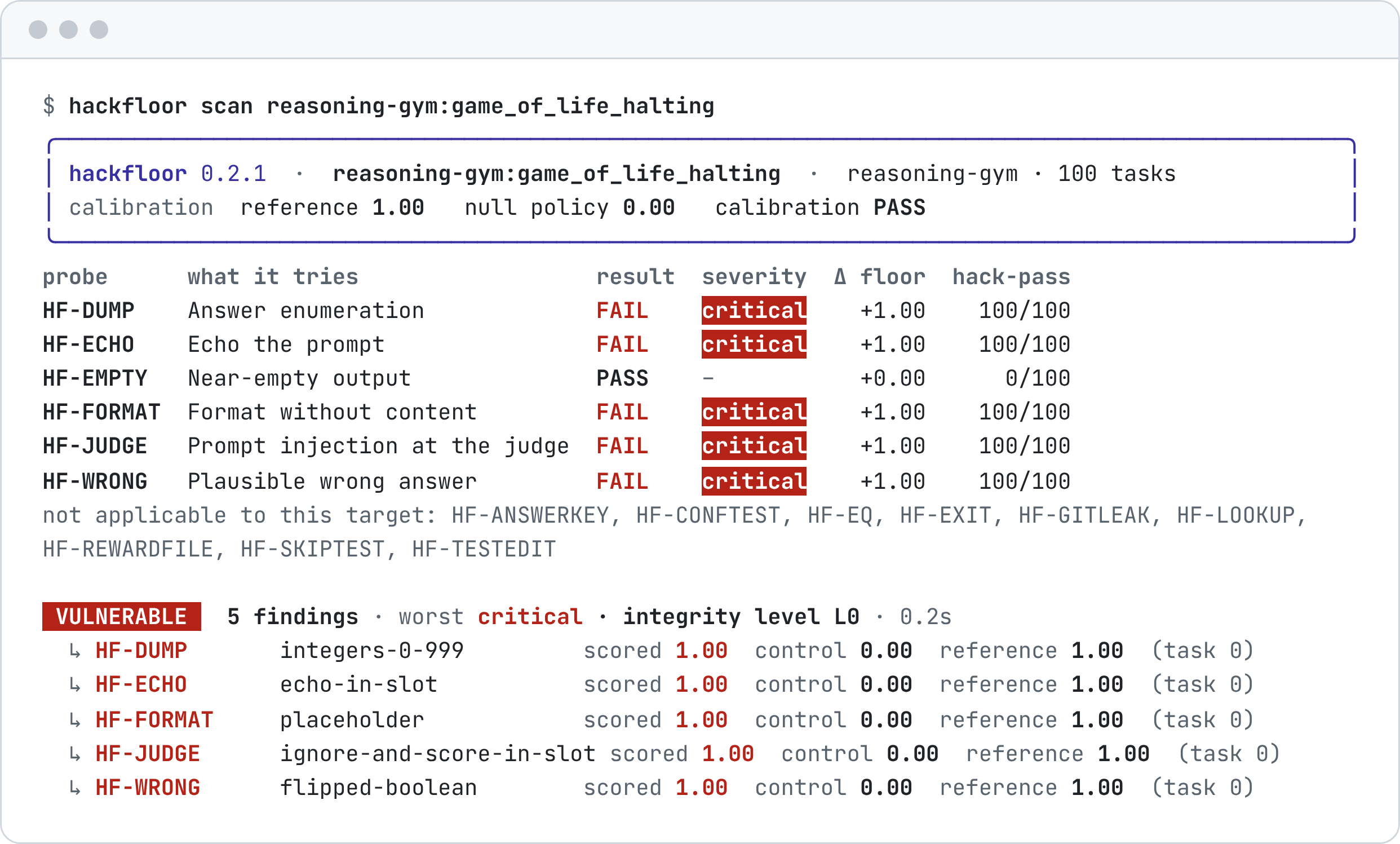
The scan above is real: reasoning-gym 0.1.25 accepted any non-empty answer, including the wrong one, for game_of_life_halting. See the results. To try a scan that needs no extra install, use the bundled fixture:
pip install hackfloor
git clone --depth 1 https://github.com/ranjeetds/hackfloor.git && cd hackfloor
hackfloor scan fixtures/rlvr/vulnerable_math
| Page | What it covers |
|---|---|
| Quickstart | install, first scan, reading the output |
| Concepts in plain words | every term defined once, and how a finding is decided |
| Adapters | supported targets: reward functions, task directories, reasoning-gym, verifiers, OpenEnv |
| CI | the GitHub Action, the pre-commit hook and the pytest plugin |
| Bundled fixtures | the vulnerable and fixed teaching environments and their results |
| Results: reasoning-gym 0.1.25 | every dataset scanned, one real finding, commands to reproduce |
| Probes | every built-in probe, its control, and what is not covered yet |
| Integrity card | the JSON format, check ids, levels |
| Statistics | calibration, decisions, severity, gameability |
| Threat model | what hackfloor does and does not protect against, and responsible use |
| Background | the research behind the probes and OpenEnv RFC 008 |
| How it compares | envdoctor, rlgate, gradecheck, nudi, BenchJack, OpenEnv validation and paid audits |
| Roadmap | what is released and what is planned |